⬇️ If you would like to understand what tools are available for calculating your SME or startup carbon footprint for the first time, read on!
➡️ If you’re not sure what a carbon footprint is, or how it works, first check out our climate change page to get your head around the basics.
Why you may need to use a carbon calculator
Maybe one of your big clients is asking you to report your carbon footprint to them. Or perhaps you need to report your footprint as part of trying to win new work, or maybe it’s a new regulation that now applies to you.
Where to start? Here are the key principles.
Not all carbon calculators are equal
Calculating a corporate carbon footprint comes with a lot of nuance and technical methodology, and if you’re not careful, you may end up with a very inaccurate footprint. This might lead you to reporting wrong information (which, depending on where you’re reporting to, may have its own various consequences), and will be useless in helping you determine a good carbon reduction plan.
For example, using a calculator based on UK energy figures will spit out bad data if you’re a business based in the US. Geography matters! Your sector matters too – if most of your carbon impact is with your suppliers, a calculator only focusing on Scope 1 and 2 emissions will miss all of your emissions in Scope 3 (the Scope that’s most relevant for you).
However, using the right online calculator for your business is an excellent starting point to mapping out and reporting your carbon footprint. It will give you a good enough understanding of where your biggest emissions are coming from, and point you to where taking action would likely be most effective.
Good enough is better than perfect
Climate action does not require perfection. It’s actually much better to begin taking action quickly off of reasonably good information, than waiting a long time for a perfect carbon footprint before getting started. Climate change is a time sensitive problem.
So you don’t need to invest big budget into your carbon footprint if that’s just not feasible. Use this guide to find the right free or low-cost calculator, so you can get going on what actually matters – swift, meaningful action. Taking this approach will help you be seen as a credible, serious business in your clients’ eyes.
How does a carbon calculator work?
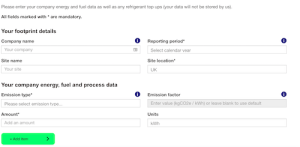
A carbon calculator is a tool that allows you to input your carbon-emitting business activities, like electricity usage, miles driven, flights taken, goods purchased, etc. It then applies the right calculations in the background to convert these activities into your carbon footprint. There’s an internationally agreed methodology for these conversions called the Greenhouse Gas Protocol.
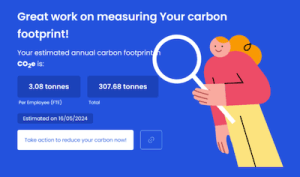
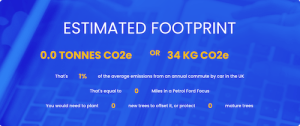
The calculator will tell you the total CO2 emissions (or CO2e – carbon dioxide equivalent) in KGs or Tonnes, and will often break the total out into different categories, so that you can see where the biggest emissions are coming from.
What am I expected to do with the information the carbon calculator gives me?
You can then use this information to understand where you can tweak your business to lower your emissions. For example, can you switch from flying to taking the train, or can you switch to purchasing renewable electricity instead of fossil fuel-based electricity, etc.
It’s best to focus on lowering your biggest emissions first, but keeping it within the realm of what’s realistic. You may have some quick wins that are easy to change, but there may also be some big emission areas that may take you years to change. This is expected and normal.
Which carbon calculator should I use?
Many different calculators are available online – some are free, some are paid, some cover a specific region, some focus on specific types of activities.
We’ve created this guide to help you make sense of everything and find the calculator that’s right for your business, so you end up with as accurate and credible of a carbon footprint as possible (without hiring expensive consultants).
Here are the key elements to consider when choosing a carbon calculator:
- Does it cover all your main business activities: Take a look at the inputs the calculator asks for, and ensure that no major part of your business is missing. You know your business best. If you’re a consultancy relying on lots of travel to client sites, ensure the calculator asks for this data (flights, for example). If you’re a manufacturer that purchases a high volume of inputs to make your products, ensure the calculator covers this, too (purchased goods, for example).
- Does it cover your geographic location(s): The amount of CO2 emitted to produce electricity varies widely across countries. Some countries use quite a lot of renewable energy, and this means that the CO2 emissions associated with businesses using this energy are lower. While other countries may not have any renewables in their electric grid, so businesses operating in these locations will be in turn emitting more CO2. Ideally the calculator you use will allow you to input your business activities by country, so it can apply geography-specific figures to your business.
- Does it ask for the right level of granularity: Some calculators ask for very detailed inputs, like data from utility bills. Others are set up to use industry averages and estimations, allowing you to bypass entering information that’s very specific. Of course the more accurate detail you can enter, the better – but if that’s simply not feasible, choose a calculator that will help you along by substituting with averages and estimates.
- Is it using the Greenhouse Gas Protocol methodology: Check in the calculator’s description or T&C’s for this. The GHG Protocol is the main internationally agreed methodology for estimating business carbon footprints.
- What extra bells and whistles could you benefit from: Can the calculator save your information so that you can go back annually to update and track your reductions? Can it suggest an action plan based on your results? Check out what useful features it may provide and if these are useful to you. But be wary if it offers to ‘offset’ your emissions so you can become ‘carbon neutral’! Offsetting is not the easy solution providers like you to think it is.
What else to keep in mind:
- Start small: Begin by focusing on Scope 1 and 2 emissions, which are often simpler and easier to calculate. Once you have your head around these, you’ll be more ready to tackle Scope 3. Familiarize yourself with the Greenhouse Gas Protocol if you’re not yet sure what is meant by Scopes 1 – 3.
- Be transparent: Always include information about how you calculated your footprint alongside reporting it. Did you use a specific calculator? Did you leave out any key business activities from the data? Did you have to estimate or ‘ballpark’ any of the inputs? Which financial year did you use for the calculations? All of this provides useful context to the receiver of the information to interpret it correctly, and avoids greenwashing.
- Work with an expert: If you can, work with a carbon accounting expert. You may not be able to afford to pay a big consultancy, but there are also many freelancers and SME-focused NGOs that can help you, sometimes as part of an SME course. They may be low fee or no fee, so it’s worth exploring these options. You can find many of them in our databases.
- Follow a recognised standard: Ensure that whatever tools you use are based on the GHG Protocol. This makes sure that your approach is aligned to how all other businesses calculate their footprints. It also allows you to report your data in a standard way, and to be transparent and credible about your approach.
How to get started
Use a good AI prompt to find the
right calculator for you
We’re all about working smarter, and not harder. Now that you understand the fundamentals and have your own good judgment about what works and what doesn’t, we recommend using a good prompt to narrow down your calculator options.
Try it out – paste the following prompt into an AI app of your choice and tweak based on your own requirements:
Which are the best 3 corporate carbon calculators for my small business? Please use the following criteria to narrow them down:
must be suitable to [insert your sector],
must be free,
must cover site locations in [geography X and Y],
must be based on the GHG Protocol,
and [does not require detailed invoice data entry].
It should cover all 3 scopes.
Of course all the typical disclaimers apply to this advice! Always use your own good judgment, and treat AI as an additional helpful tool, rather than an absolute accurate answer.
The usefulness of AI outputs heavily depends on how well you craft your prompt, including all necessary details and ensuring good structure. If you use an identical prompt with different AI apps, you’ll get different results. That’s because different AI models are structured differently, and may need differently structured prompts.
To help you get the best outcome, here are model prompts optimised for some of the most popular AI tools. Ensure you tweak them to your own needs.