
At Howtoesg, we’re all about working smarter, not harder—especially when it comes to using AI for sustainability. So we ran an experiment: could AI help us quickly find the best carbon calculators for small businesses?
We tested four leading AI tools—ChatGPT, Claude, Gemini, and Perplexity—to see if they could consistently recommend suitable carbon calculators that cover all parameters that are important to small businesses. Spoiler: they didn’t. Even when we asked the exact same question, each AI gave different answers every time. Here’s what we learned about using AI for sustainability, and why your own judgment still matters.
The experiment: using AI for sustainability
We used a structured question from our DIY guide to carbon calculators for SMEs and startups and asked each AI the same thing:
Prompt:
Which are the best 3 business carbon calculators for my small business? They should cover all 3 scopes.
Please use the following criteria to narrow them down:
- must be suitable to manufacturing,
- must be free,
- must cover site locations in US and China,
- must be based on the GHG Protocol,
- and does not require detailed invoice data entry.
Results: Same prompt, different answers
Here’s what each AI tool recommended when we asked the identical prompt:

There was some overlap – Hedgehog and SME Climate Hub came up a few times – but overall, the results varied widely.
Testing AI-specific prompts
We took it a step further. Each AI was asked: “What’s the best way to ask you this question?” Based on their advice, we restructured the prompt to better fit each model’s strengths.
To control for variables, we used a fictional business:
-
Sector: Kids’ toy manufacturing
-
Locations: China (factories), US (offices)
-
Size: 4 employees
-
Budget: Free tools only
-
Needs: Manual data entry, client reporting
New results: tailored prompts, still no consensus
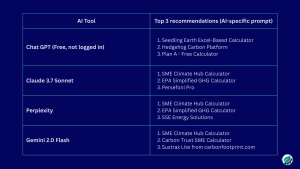
Even with custom prompts, results changed again. And when we re-ran the same question through each AI a second time, the answers changed yet again.
Key takeaways about using AI for sustainability
So what did we learn?
🧠 1. AI is great for research, not decisions
AI can help you shortlist tools, especially if you’re unfamiliar with carbon accounting. But don’t take the first answer at face value. Ask follow-ups. Compare results. Think critically.
✍️ 2. Your prompt matters—a lot
A vague question will get vague results. Use detailed, structured prompts tailored to the model. (We share example prompts in our DIY guide.)
🔄 3. Expect different answers every time
Even with the same prompt, results vary between AI tools and even across sessions. That’s not a bug—it’s just how they work.
🤖 4. Each AI model has different strengths
Claude tends to be more structured, while Gemini offers broader overviews. ChatGPT is conversational but more variable in free mode. Know what you’re working with.
📢 5. Watch for bias and visibility games
AI is trained on what’s available online. Some recommendations may appear because a tool is well-optimized for AI visibility, not necessarily because it’s the best option.
Final Thoughts
This experiment taught us that AI can absolutely save time during early research—but it’s no substitute for critical thinking or human expertise. Choosing a carbon calculator still requires you to understand your own needs, check the tool’s features, and evaluate what’s most practical for your business.
Want help crafting your own AI prompts or evaluating carbon tools? Check out our DIY Guide to Carbon Calculators for SMEs and Startups.